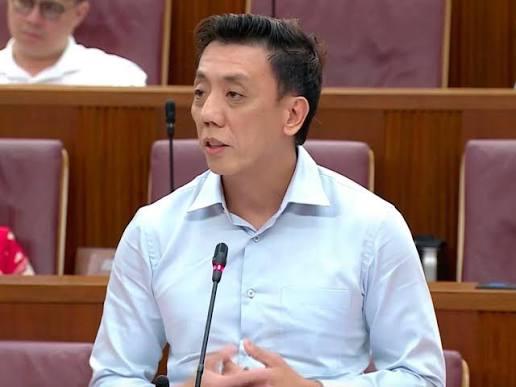
First, why did Jamus Lim circulate only a partial clip of what Education Minister Desmond Lee said in Parliament?
Context matters — especially in serious policy debates. Extracting a short segment from a longer speech risks distorting the substance of the argument. When the full remarks are considered, it becomes clear that the Minister was describing an established policy approach, not announcing a new direction.
By omitting the broader context, the clip creates the impression of a so-called “whisper of convergence” — as though the Government had suddenly shifted its position. That impression is misleading. The approach outlined is one the Ministry of Education (MOE) has pursued for years.
Empathy versus Efficiency
Second, Jamus Lim claims our classrooms are geared towards efficiency rather than empathy. This itself commits a false dichotomy.
A false dichotomy presents two options as mutually exclusive when they are not. Efficiency and empathy are not opposites. Singapore’s classrooms are designed to achieve both:
Efficient allocation of finite resources, and
Targeted, empathetic support for students who need additional help
In public policy, especially in education, both principles must coexist.
The Real Issue: Resource Allocation Under Constraints
Third, Jamus Lim characterises the Government’s position — that broad-based reductions in class size may come at the expense of teaching quality — as a false dichotomy between class size and teacher quality.
That is an incorrect characterisation.
The Government’s position is not “class size versus teaching quality.” It is more nuanced and grounded in basic economics: education systems operate under finite budgets and limited teacher supply. These constraints create genuine trade-offs.
Given limited resources, where should marginal dollars go?
Hiring more teachers to reduce class sizes across the board?
Paying higher salaries to attract and retain top talent?
Investing in teacher training and professional development?
Providing targeted support for students who need more intensive intervention?
These are not logical fallacies. They are strategic allocation decisions.
The real question is not whether smaller classes are beneficial in principle. It is: who should be placed in smaller classes so that the overall teaching quality is not diluted, given finite resources?
Broad-based reductions require careful trade-offs.
What MOE Has Actually Been Doing
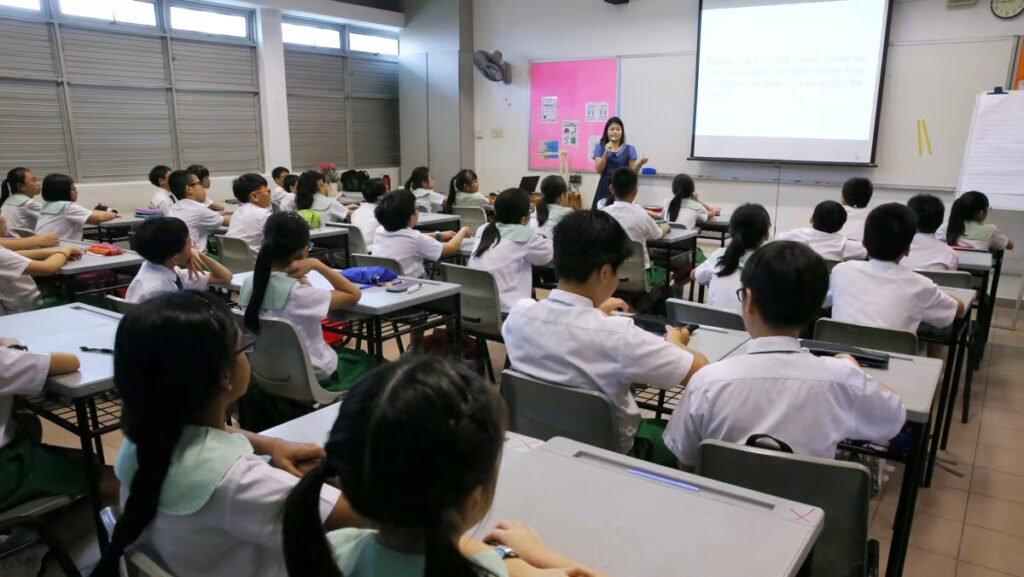
Historically, class sizes in Singapore were as large as 45 or 46 students. They have been reduced progressively over time.
In 2005, MOE lowered Primary 1 and 2 class sizes from 40 to 30 students.
By 2024, the average class size was around 29–30 students.
More importantly, MOE has consistently directed additional resources where they are most needed:
The Learning Support Programme provides pull-out classes of 8–10 students for literacy and numeracy support.
Specialised schools such as NorthLight and Spectra operate with classes of about 20 students to provide more individualised attention.
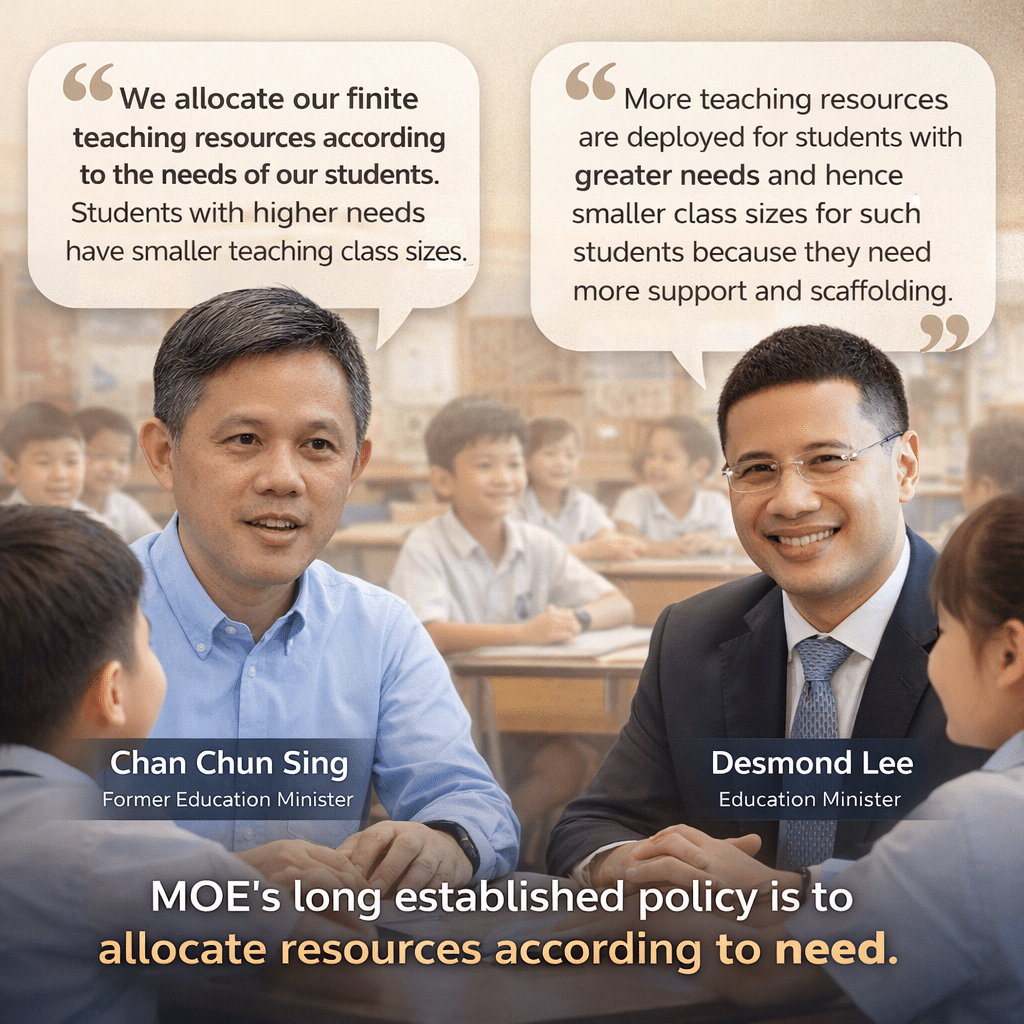
This is not a new “convergence.” It is a long-standing targeted strategy: smaller classes where they matter most.
What Does the Evidence Actually Say?
Major meta-analyses and OECD reviews consistently find that teacher effectiveness has a larger impact on student outcomes than marginal reductions in class size.
Even Jamus Lim’s own phrasing is revealing. He claims there are “reams and reams of evidence” that students perform better when classes are “a lot smaller.” The key phrase is “a lot smaller.”
Yes — extremely small classes can produce measurable gains. But:
How large must the reduction be?
What is the magnitude of improvement?
At what fiscal cost?
What are the opportunity costs elsewhere in the system?
Serious policy claims require serious substantiation. If the evidence is as overwhelming as claimed, it should be presented transparently — with a clear accounting of magnitude, context, and cost.
That, too, is basic economics.
A Simple Question for Parents
Ask any parent: would you rather your child be taught by a strong teacher in a moderately sized class, or a mediocre teacher in a very small one?
Education policy is not about ideological binaries. It is about trade-offs under constraints.
The Government’s position recognises this reality. It is not “teacher quality versus small classes.” It is how to allocate finite resources to maximise overall student outcomes — while ensuring those who need more help receive it.
In policy debates, context matters. So does evidence.