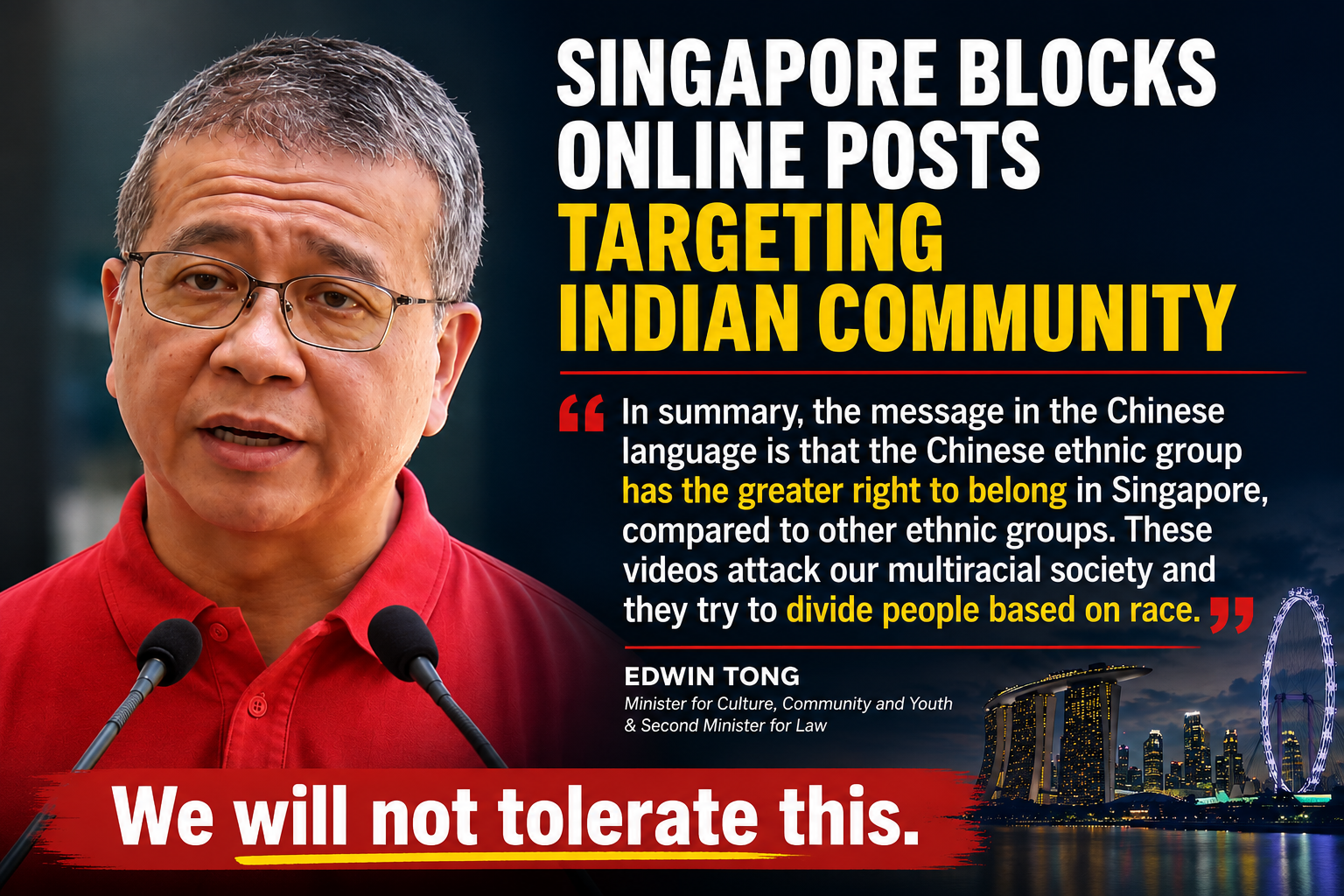
The Singapore Government has moved decisively against a series of foreign-based online posts that sought to stir racial tensions between Chinese and Indians in Singapore.
The Singapore Police Force (SPF) recently issued Disabling Directions under the Online Criminal Harms Act (OCHA), requiring YouTube, Facebook and X to block Singapore users’ access to 14 posts assessed to be harmful to racial harmony.
According to the Ministry of Home Affairs (MHA), the posts contained inflammatory narratives targeting Singapore’s Indian community and undermining the country’s longstanding model of multiculturalism.
False Narratives Designed to Divide
The online content first emerged in Chinese-language information spaces and promoted claims that Singapore was facing a crisis over cultural identity and ethnic politics. The posts sought to portray Indians as a growing threat to Singapore’s social fabric and advanced several misleading narratives.
Among other things, they claimed that Singapore’s multiracial policies were merely a façade designed to appeal to Western values, and that the country’s stability was due primarily to its Chinese-majority population rather than its commitment to multiculturalism.
The content also alleged that Indian politicians in Singapore would favour Indian immigrants over other Singaporeans, and suggested that the Government’s approach towards China and immigration would eventually lead to negative consequences for the country.
Misleading Images and Derogatory Language
To support these claims, the posts selectively used photographs and videos taken in areas such as Little India and Pagoda Street. These images were presented out of context to create the impression that Singapore was being “overrun” by Indians.
Authorities noted that some of the content employed derogatory and demeaning language when referring to Indians, including comparing increases in the Indian population to a growing “concentration of curry”.
MHA and SPF assessed that the posts were likely to constitute offences under Section 298A of the Penal Code, which criminalises acts that promote enmity, hatred or ill-will between racial groups, or prejudice the maintenance of racial harmony in Singapore.
Foreign-Originated Content
Investigations found that the content likely originated from a platform based in China before being circulated across multiple websites and social media platforms.
The authorities also observed deliberate efforts to amplify these narratives within Singapore’s information space, raising concerns about attempts to sow discord between different communities.
MHA described the campaign as a malicious effort to incite ill-will against Singapore’s Indian community, including Indian migrant workers who contribute significantly to the country’s development and economy.
Protecting Singapore’s Social Cohesion
Singapore’s success has long been built on the principle that people of different races, religions and backgrounds can live and work together in harmony. Attempts to turn one community against another strike at the heart of this social compact.
The Government has made clear that it rejects both nativism and xenophobia, and that efforts by foreign actors to interfere in Singapore’s racial harmony will not be tolerated.
As online disinformation campaigns become increasingly sophisticated, Singaporeans should remain vigilant and critically evaluate information encountered on social media. Racial harmony is one of Singapore’s most valuable assets, and safeguarding it requires the collective effort of all Singaporeans.
The authorities have urged the public to reject divisive narratives and refrain from sharing content that seeks to undermine trust and cohesion among Singapore’s diverse communities.