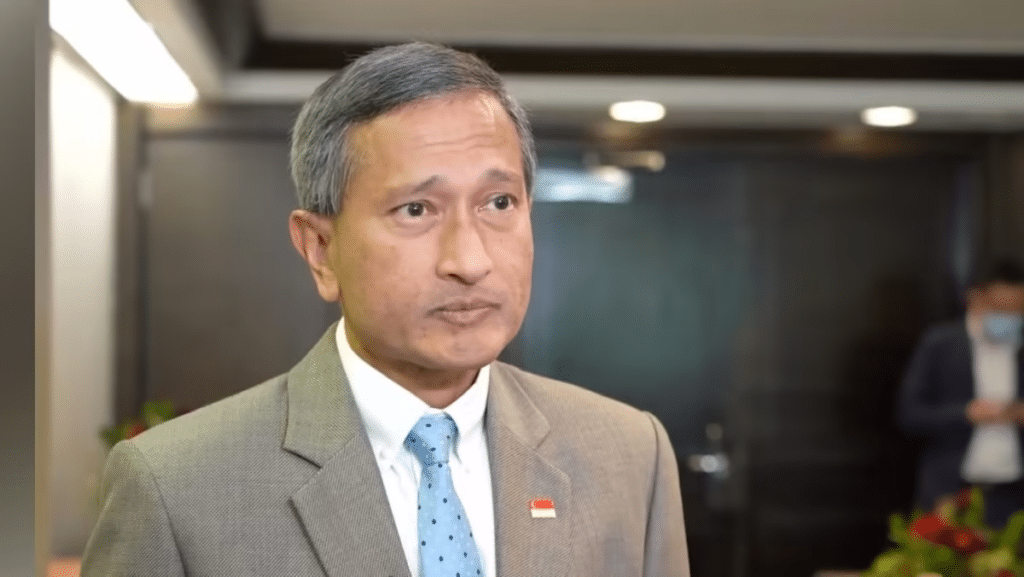
“In a more volatile world that is increasingly inimical to the security and survival of small states like Singapore, we must try to shape global norms by making common cause with as many friends and partners as possible in order to support multilateralism, the rule of law and the UN Charter,” Minister for Foreign Affairs Dr Vivian Balakrishnan said in Parliament (11 Nov 2024).
Singapore does not take sides, he said. We uphold principles and this meant that from time to time, Singapore has had to say ‘no’ to other states, some of which can be our close partners or even superpowers, he said.
“This longstanding, consistent and principled approach to foreign policy has served us well and afforded us strategic manoeuvring space.”
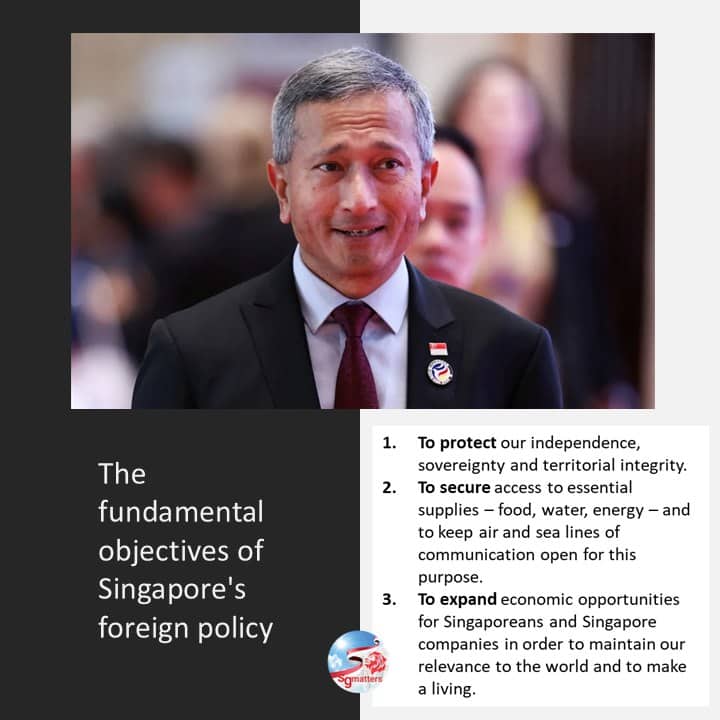
Is not taking side a sustainable position?
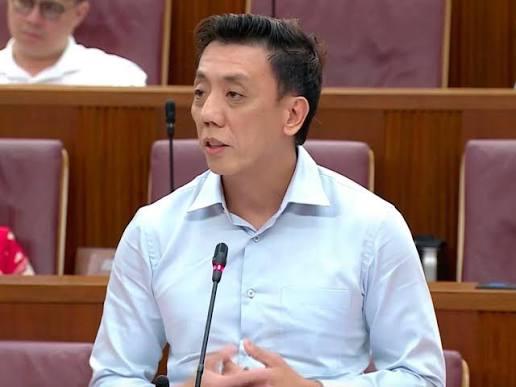
WP Gerald Giam asked how sustainable it is for the Singapore government to maintain the stance of not taking sides in an increasingly polarised world where more and more countries in our region are doing exactly that.
Dr Vivian explained that not taking sides is ‘the most sensible position for Singapore’, Singapore being a multi-racial, multi-religious and multilingual city state and an island in the heart of Southeast Asia in which all the superpowers and indeed middle powers have a stake.
It is not only the most sensible position for Singapore, it is the essential position given our national circumstances, our geography and our economic and strategic role.
Because of our geography and our economic role, we do best when we can engage everyone – not by aiming to take sides or being a vassal state or a proxy state, which in fact, will be a recipe for disaster and invite the re-creation of Southeast Asia as an arena for proxy wars.
Prerequisites for adopting a neutral position
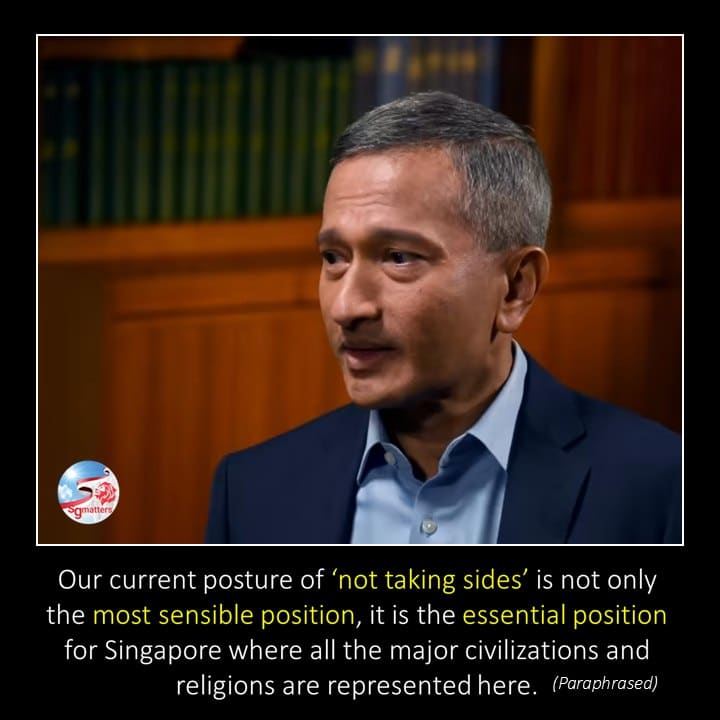
In order for Singapore not to take sides and to uphold principles, we need domestic cohesion and consensus, including in this House, Dr Vivian said.
This is because if foreign powers believe that they can erode our resolve by dividing us, they will. This isn’t mere rhetoric. All the major civilizations and religions are represented here.
“So I am making the point that there needs to be domestic consensus and our domestic politics must stop at the water’s edge, and that we have been able to do for 59 years. The point I am making is that we must continue to do so,” said Dr Vivian.
In foreign affairs, friendship is not a shield
To Gerald Giam’s point that there is no global policeman to enforce international laws, Dr Vivian said, “If we were ever to get into a security or military conflict, no one is going to rescue us. We will be on our own. Do not ever believe for a moment in foreign affairs that friendship is a shield; that friendship makes you immune to threats,” said Dr Vivian.
“That is why we continue to have national service. That is why we continue to spend a significant proportion of our budget on defence. And that is why, in a paradoxical way, we have no enemies. We have lots of friends, because people know our relationship is not one of dependency, is not one of sycophancy, is not one of acting on others people’s behalf. We pay for what we need, we defend our interests, and we are united in doing so,” he said.
“And given that we are getting into a more volatile, complicated and threatening world, this ability to stand on our two feet, united as one people, and with sufficient reserves and the wherewithal – both fiscal and strategic – is all the more crucial,” he added.
Who are the like-minded countries to find common ground?
To Gerald Giam’s query on who the like-minded countries are, Dr Vivian explained them in concentric circles with ASEAN being the most important innermost concentric circle.
Within ASEAN is a common economic agenda even at a time when the world is turning negative on trade, Dr Vivian said. Beyond ASEAN, it is the dialogue partners of ASEAN.
“And finally, at the UN, we are the conveners of this forum called the Forum of Small States, which in fact is the majority of the membership of the UN.”
Small states find Singapore to be a dependable, reliable resource in terms of thought leadership, sharing of capability development and human capacity development.