In a land-scarce city like Singapore, every square metre counts. As the city-state continues to urbanise, it faces dual challenges: water sustainability and rising urban temperatures.
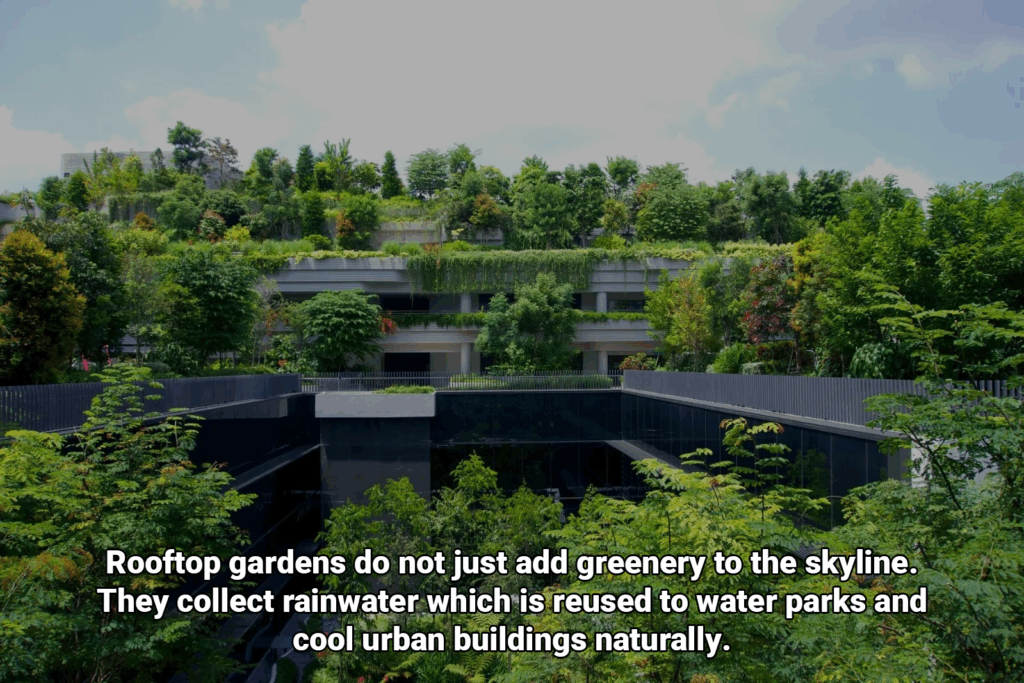
One elegant solution gaining traction across both public and private developments is the integration of rooftop gardens with rainwater harvesting systems.
These green rooftops not only help to collect and reuse rainwater but also serve as natural cooling systems, making them a powerful tool for sustainable urban living.
Turning Rain into Resource
Singapore receives abundant rainfall averaging over 2,000 mm annually. It has long treated water as a strategic national priority.
Gardens by the Bay is an example of how rooftop space is used to harvest rainwater to play a key role in supporting the site’s sustainability efforts.
Rainwater is collected from the expansive glass roofs of the Flower Dome and Cloud Forest, as well as the Supertree canopies and surrounding landscaped areas. This harvested water is stored in underground tanks and reused throughout the gardens.
It supplies the automated irrigation systems that water over a million plants and is also integrated into the cooling systems of the conservatories, helping to regulate temperature and humidity in an energy-efficient way.
In some Supertrees, the rainwater even supports evaporative cooling. By closing the loop on water use, Gardens by the Bay reduces reliance on potable water and demonstrates how urban green spaces can operate sustainably in a dense, tropical city like Singapore.
While Singapore is famous for its cutting-edge water recycling plants (NEWater), more decentralised solutions like rooftop rainwater harvesting have quietly taken root.
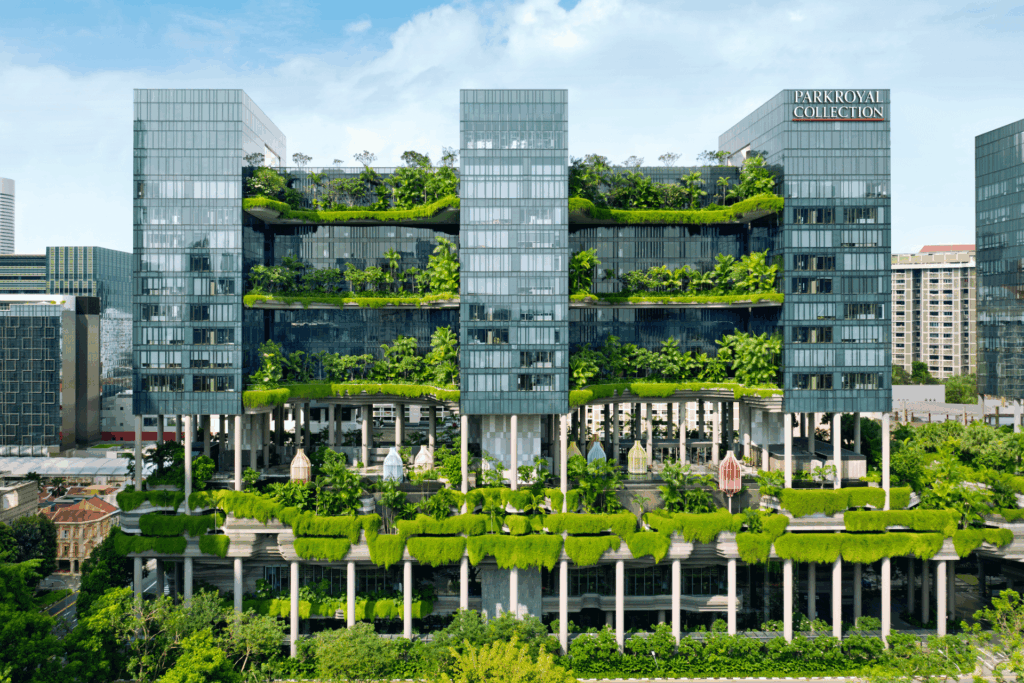
Buildings such as the PACKROYAL Collection Pickering exemplify this green shift. Its iconic sky gardens and green terraces don’t just beautify the city skyline—they also harvest rainwater which are then used for irrigating plants and flushing toilets. This closed-loop system has helped the hotel save thousands of cubic metres of potable water annually, earning it a BCA Green Mark Platinum Award.
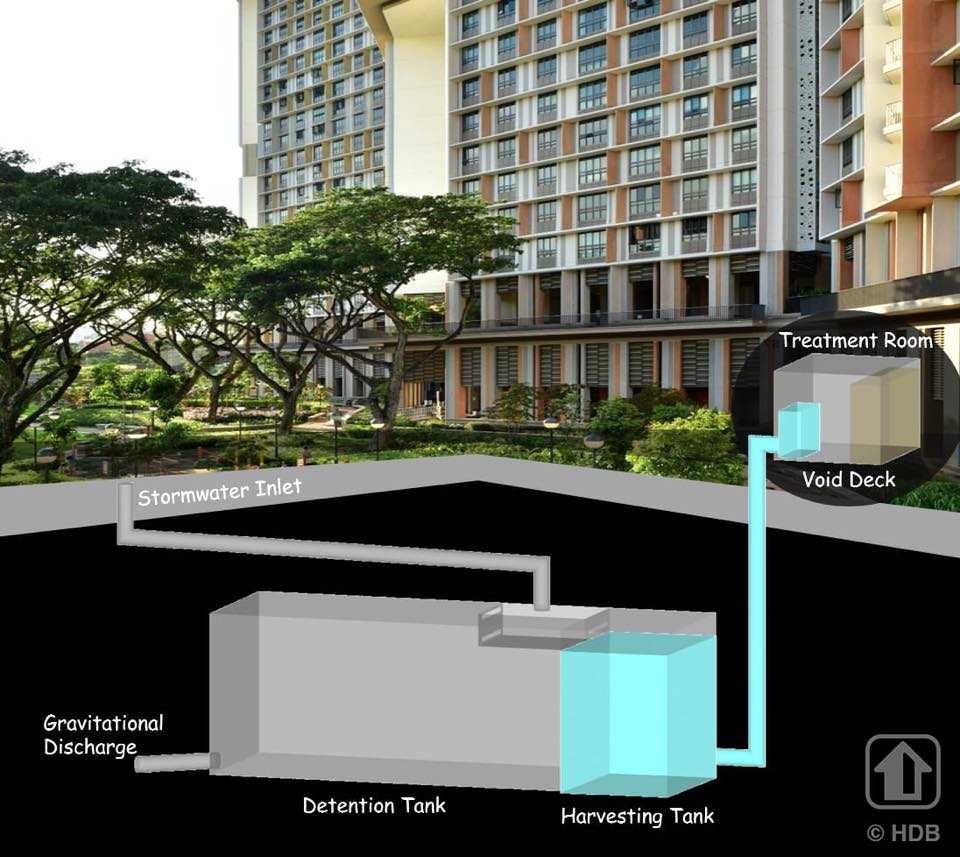
In HDB precincts, large-scale initiatives are also underway. The UrbanWater Harvesting System (UWHS) is being piloted in mature estates like Yishun and Jurong, where rainwater from rooftops and hard surfaces is collected and reused for common-area cleaning and landscaping.
By 2027, this system is projected to save 17,500 cubic metres of water annually or the average yearly consumption of potable water of over 85 units of 4-room HDB flats.
Green Roofs: Nature’s Air Conditioner
Beyond water conservation, rooftop gardens play a vital role in passive cooling. Covered with soil and vegetation, these green roofs absorb and dissipate heat that would otherwise be trapped by concrete surfaces.
Studies in Singapore have shown that rooftop gardens can cool the immediate surrounding environment by 1.5 °C and reduce surface temperatures by up to 18 °C.
This cooling effect translates into real energy savings. By lowering rooftop temperatures, buildings become more energy-efficient, cutting down on the need for air conditioning especially in high-rise residential and commercial developments.
In a tropical city where air conditioning is a major contributor to electricity demand, this is no small feat.
Moreover, rooftop gardens help mitigate the Urban Heat Island (UHI) effect, a phenomenon where densely built-up areas become significantly warmer than their rural surroundings. As Singapore becomes more vertical, these gardens offer a way to reintroduce green space at higher altitudes, softening the city’s concrete-heavy environment.
A Replicable Model
As other cities grapple with rising temperatures, water shortages, and limited land, Singapore’s approach offers a replicable model. Rooftop gardens and rainwater harvesting systems are cost-effective, scalable, and adaptable to both new and existing buildings.
They remind us that sustainability need not always come from grand infrastructure. It can also be achieved through thoughtful, layered design.