
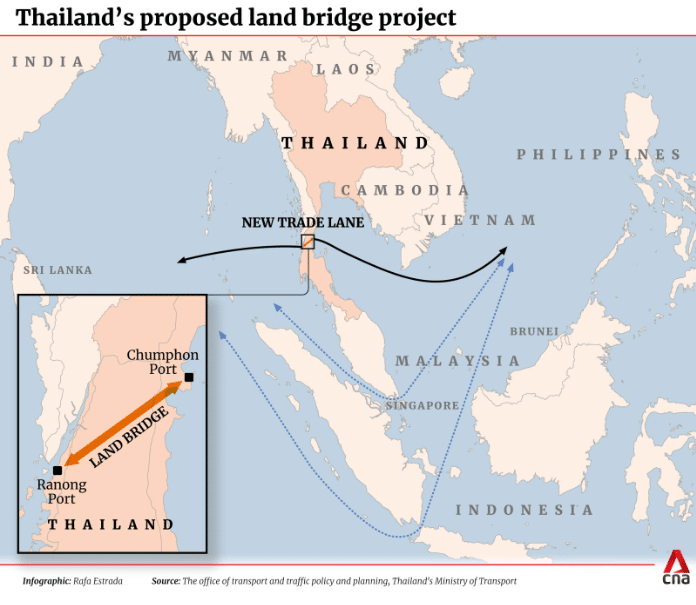
Thailand is pushing forward with its $36 billion Land Bridge project which aims to connect the Andaman Sea and the Gulf of Thailand via a new overland logistics corridor. The new trade route will bypass the congested Straits of Malacca, where Singapore currently serves as the key maritime chokepoint.
In March this year (2025), Thai Transport Minister Suriya Jungrungreangkit confirms that the Land Bridge megaproject is still being pursued, with China and Middle Eastern countries showing an interest.
Among them was Dubai Port World, which showed a strong intention to participate in the bidding process, he said.
Construction is expected to begin in 2026, with partial operations by 2030.
The project promises to cut shipping times, reduce fuel costs, and create a new logistics artery for global trade between the Indian and Pacific Oceans.
A New Trade Route to Challenge the Status Quo?
For Singapore, which thrives on transshipment and port-based logistics, this could represent a significant strategic shift.
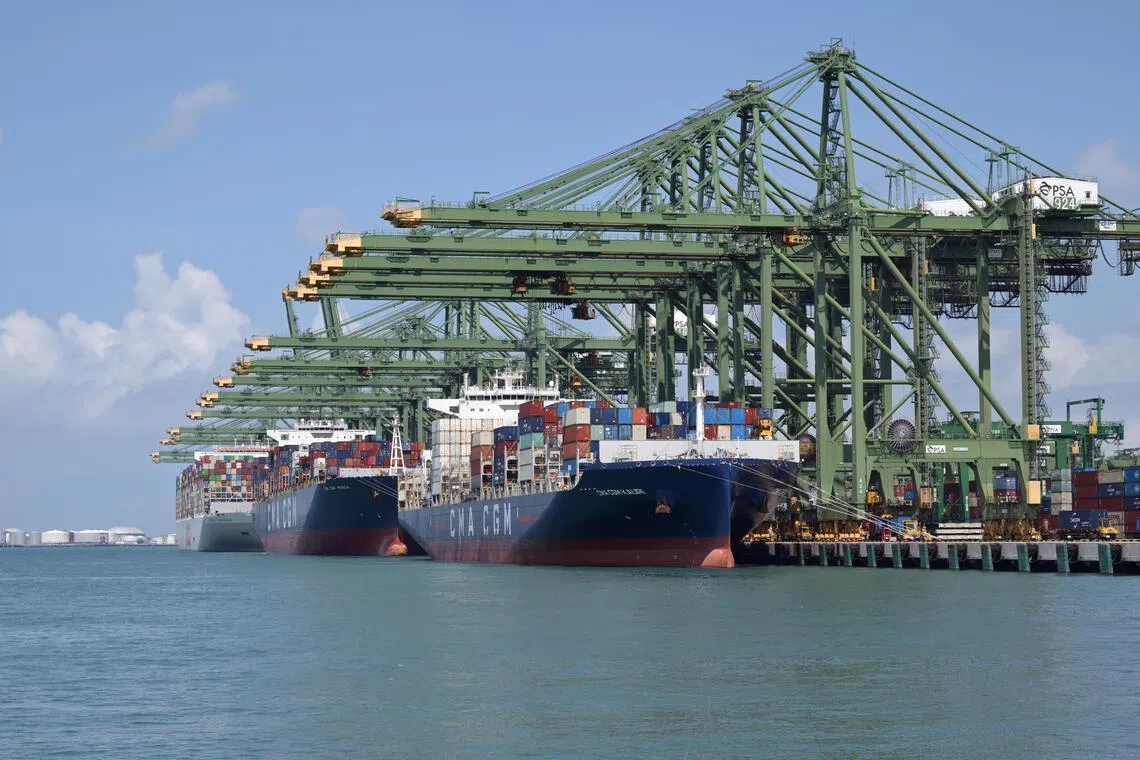
A successful land bridge could significantly impact Singapore’s geostrategic choke-point advantage and divert some shipping traffic away from Singapore, especially container transshipment, bulk cargo, and oil that currently flows through Singapore.
This in turn, will impact port activity, jobs, and GDP contributions from maritime services.
Challenges remain
The Land Bridge would cut across the narrowest part of the Kra Isthmus, an area rich in biodiversity and home to local communities.
Environmental impact assessments (EIAs) are underway, but public opposition from environmental groups and residents could delay or derail parts of the project.
In addition, indigenous land rights and livelihood disruption are key concerns, especially for fishing communities and rural settlements.
Also, Thailand has experienced frequent changes in government and policy direction, thus making long-term megaproject continuity a challenge.
How can Singapore respond?
Singapore can double down on efficiency. With the Tuas Mega Port coming online in phases through 2040, Singapore is already upgrading its infrastructure with automation, AI, and deep berths to handle larger vessels and faster turnaround times.
Singapore can lead the green push with green bunkering, electrified logistics, and ESG-aligned port operations.
Singapore can also strengthen its logistics & trade services by expanding its role in supply chain finance, maritime insurance, and digital trade platforms — areas that are difficult to replicate quickly.
Singapore’s advantages
Supply chain finance:
Singapore has a strong financial ecosystem, with global banks, fintechs, and trade finance specialists operating locally.
Its regulatory framework is trusted and transparent — critical for international businesses.
Its proximity to major trading companies, logistics hubs, and port facilities allows real-time integration between goods and capital.
Building a deep financial system with trusted institutions, regulatory integrity, and global connectivity takes decades — something that cannot be replicated quickly.
Singapore is also home to top marine insurers, brokers, and legal firms specializing in Admiralty Law and marine claims.
The Maritime and Port Authority (MPA) and global insurers work closely to streamline compliance and risk management.
Singapore is also a center for maritime arbitration and dispute resolution.
This is another ecosystem that cannot be easily replicated.
Conclusion
The Thai Land Bridge is a bold and potentially disruptive idea — but it’s not a death knell for Singapore. Instead, it is a reminder that regional competition is rising, and agility, innovation, and value-creation will determine the winners in the future of global shipping.
Singapore’s edge isn’t just geography — it’s trust, resilience, and smart strategy. That advantage still holds strong.