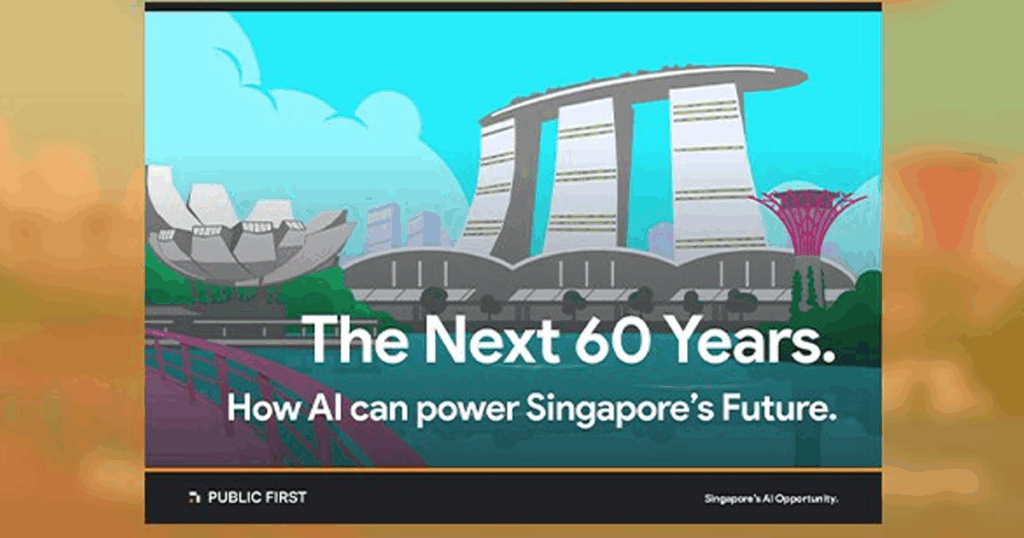
The current wave of innovation in AI is set to accelerate growth worldwide. For Singapore, it offers a new opportunity to thrive, according to Public First, a policy, research, opinion and strategy consultancy based in the United Kingdom.
Singapore has some of the greatest regional potential from AI, the report says.
The country is well-prepared for the AI transformation because its strong digital infrastructure renders it well positioned to grow through AI adoption across the economy.
Its public policy framework for AI is also highly developed and could support widespread AI adoption.
To take full advantage of AI, Singapore will need to keep its workforce’s AI skills up-to-date, the report said.
The potential of AI is not lost on Singaporeans.
Indeed, half of Singaporeans polled by Public First said they are using AI at least once a week both at work and in their personal lives. In fact, Singaporean workers are some of the fastest in the world at adopting AI skills.
Current adoption of AI largely worker-driven
In fact, the current adoption of AI tools is largely driven by the workers themselves.
58% of current AI users said they had largely chosen to use AI tools at work themselves, while 39% said they had been encouraged to use AI tools by a colleague or boss.
This is truer still among younger workers – with 84% of 18-24 year old Singaporean workers saying they decided to use AI at work themselves, rather than being encouraged to do so by their boss or by their colleagues.
Singaporeans keen to keep AI skills up-to-date
Singaporean workers already have some of the highest digital skills in the region, and are considered the fastest in the world at adopting AI skills.
There is no lack of interest in wanting to learn more about AI.
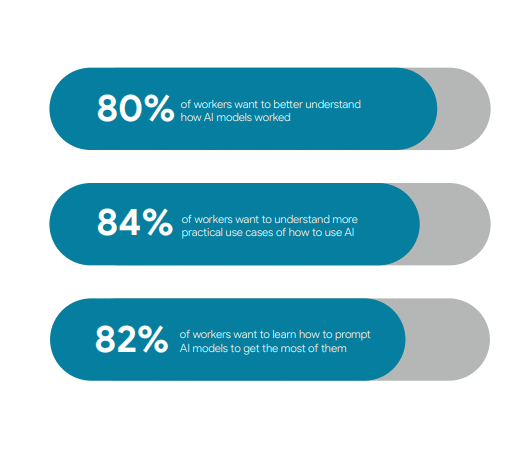
82% of Singaporean workers told Public First they would be interested in skills training to help them use AI.
In particular, they are interested in developing practical skills such as understanding how the AI models work and how to prompt AI models to get the best out of them.
Traineeship Programme at Google Singapore
Google and the Infocomm Media Development Authority (IMDA) have collaborated on Skills Ignition SG Traineeship Programme, a skilling
initiative focused on workforce development that helps Singapore build a highly skilled working population to help retain its comparative
advantage.
Launched in July 2020, Skills Ignition SG aims to enhance the employability of Singaporean entry-level and mid-career job seekers by equipping them with in-demand digital skills, through initiatives like the traineeship programme.
To date, over 20,000 Singaporeans have unlocked new career opportunities through Skills Ignition SG since 2020.
The Skills Ignition SG Traineeship programme is a twelve-month programme comprising of three months external training, and a hands-on experience through the immersive nine months on-the-job training at Google.
The programme focuses on two key tracks designed to address high-demand skills: Digital Marketing (DM) and Professional
Cloud Architect (PCA).
These tracks are now redesigned to include AI into the curriculum, strategically aligning with Singapore’s national priorities in developing a robust and future-ready digital workforce.
Overall, Skills Ignition SG exemplifies a successful public-private partnership, addressing the evolving needs of Singapore’s workforce
by providing comprehensive training and practical experience in highgrowth digital sectors.
The potential of AI is far reaching.
AI can help amplify Singapore’s export across South East Asia by helping companies navigate non-tariff barriers to trade.
AI-driven logistics could help optimise shipping routes, warehousing, and inventory management. This in turn could lower costs and enhance reliability and help offset supply chain disruption.
The use of AI can offset a shrinking workforce due to an ageing population by taking over repetitive tasks.
In the field of medicine, AI can help to diagnose conditions in patients by supporting doctors as part of a routine check up or during a formal diagnostic process. It can also get ahead of future health problems by tracking and identifying subtle changes in personal health data.
After being combined with data from your smartphone or watch, AI could help provide earlier detection of emerging health conditions when they are still treatable.
Hospitals in Singapore are already employing this technology to help in the diagnostic process. The National University Hospital (NUH) uses home-grown AI to help reduce the amount of time it takes a radiologist to interpret an MRI scan, helping to free up radiologists’ time to focus on other priorities.