The NTUC has always had a close relationship with the PAP, with many of its leaders also being senior members of the party.
This connection goes back to the 1950s when the PAP, backed by unions, came to power. Over time, NTUC became the dominant union federation, while the PAP solidified its role as Singapore’s ruling party.
The PAP’s close relationship with the NTUC is not a unique Singapore phenomenon.
Globally, unions often align with political parties. Singapore’s tripartite system—linking the government, unions, and businesses—has kept industrial relations peaceful.
Rather than calling for NTUC’s independence, opposition parties should focus on winning union support, as political and union partnerships are common worldwide.
So, why is the Workers’ Party (WP) suddenly so concerned about NTUC? It’s simple: they plan to rule the country.
If WP wins the election and becomes the government, NTUC—with its strong influence over workers in many sectors—would pose a significant threat. Therefore, WP needs to weaken NTUC before they can take over.
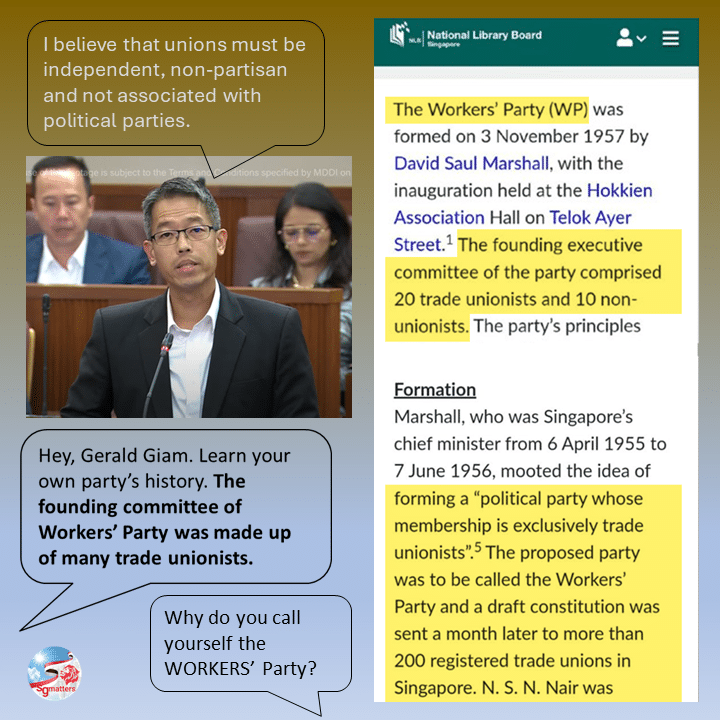
Thus, Giam’s objection to NTUC’s close association with the PAP has nothing to do with a concern for workers’ interests. It has everything to do with WP’s own narrow interest. For their own interest, they would seek to weaken a union that has done very well in furthering and protecting workers’ interests.