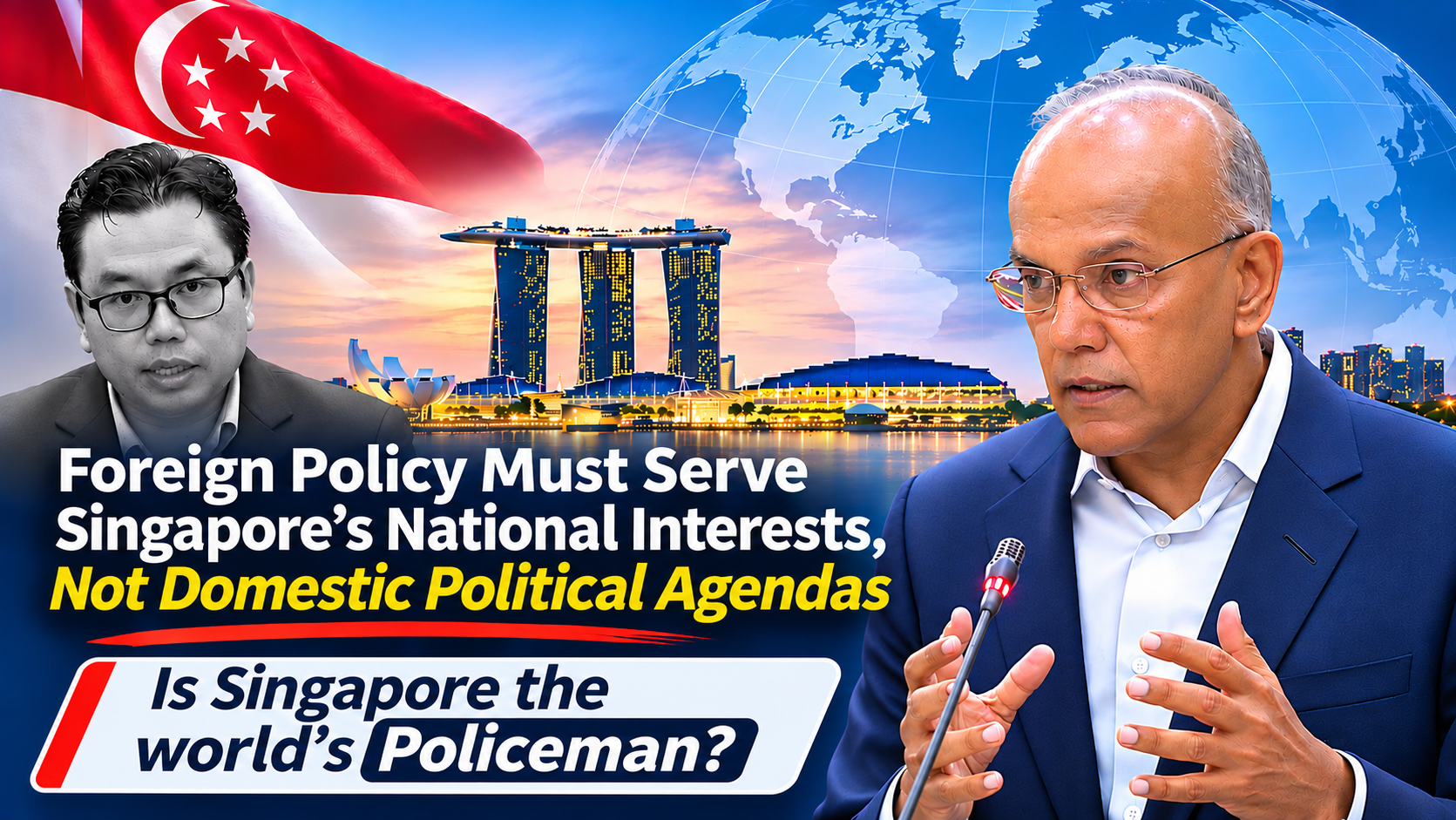

The exchange in Parliament on 4 November between Senior Minister K. Shanmugam and Workers’ Party MP Fadli Fawzi raised an important question about how Singapore should conduct its foreign policy.
What should guide Singapore’s diplomacy? Our national interests, or domestic political considerations?
The disagreement arose after Fadli questioned why the Ministry of Home Affairs (MHA) had not raised the issue of illegal Israeli settlements and settler violence in the West Bank during a meeting with Israeli officials.
He argued that Singapore should adopt a whole-of-government approach and raise such matters whenever they are relevant and important.
But relevant and important to whom? And judged against what?
These are not trivial questions. They go to the heart of how a small country like Singapore must manage its relationships with the rest of the world.
Singapore’s position on Israel is already clear
First, it is important to establish that Singapore’s position on the Israeli-Palestinian conflict is not ambiguous.
Singapore opposes illegal Israeli settlements, condemns settler violence and supports a negotiated two-state solution.
Our Government has repeatedly articulated these positions through the Ministry of Foreign Affairs. It has also gone beyond issuing statements, imposing targeted financial sanctions and entry bans on four individuals responsible for extremist violence against Palestinians in the West Bank.
Therefore, the question is not whether Singapore supports international law or whether it has taken a position on the issue.
The question is whether Singapore must repeat that position at every opportunity, including meetings convened for entirely different purposes.
As Shanmugam explained, the meeting in question concerned operational security and law enforcement cooperation. Singapore’s broader foreign policy positions are determined by the Government and conveyed through the appropriate diplomatic channels including Ministry of Foreign Affairs.
There is a distinction between an operational meeting and a diplomatic engagement intended to discuss foreign policy.
The fact that both involve foreign officials does not mean they should serve the same purpose.
Enlightened self-interest must guide our foreign policy
Shanmugam made another important point about Singapore’s approach to international law.
He said that Singapore’s approach to international law “has got to be enlightened self-interest”.
He explained:
“We are elected as MPs and ministers to safeguard Singaporeans’ interests primarily, not just principles of international law.
“Principles of international law (must be) seen through the prism of Singapore’s national interest, which is fundamental, and because we are a small country, it is important for us that international law be upheld.”
This is an important distinction.
Singapore supports international law precisely because, as a small country, we depend on a rules-based international order. We do not have the size or military strength to impose our will on others. We need international rules to protect our sovereignty, territorial integrity and national interests.
But supporting international law does not mean Singapore must appoint itself the enforcer of these laws in every country where violations occur.
Nor does it mean that every meeting with a foreign government must become an opportunity to register our disagreements with its policies.
Diplomacy requires judgement. It involves knowing when to speak, what to raise, which channels to use and, just as importantly, when a particular issue should not be allowed to derail the purpose of an engagement.
Would the same principle apply to every country?
Shanmugam’s written reply raised another question that Fadli should address.
If the Member believes MHA should use operational engagements to raise broader concerns about the policies or conduct of the countries concerned, should this principle apply consistently to all countries?
When MHA holds operational discussions with other Middle Eastern or Asian countries, should Singapore also use those opportunities to raise concerns about their respective policies or conduct?
If so, how would such an approach serve Singapore’s overall interests?
This is a question of consistency.
Singapore maintains relationships with many countries whose policies and practices may differ from ours. Some of these countries are important partners in trade, security, law enforcement and regional cooperation.
We cannot afford to treat every disagreement as a reason to turn an operational engagement into a political confrontation.
That does not mean remaining silent when important principles are at stake. It means choosing the appropriate forum and diplomatic channel to advance our interests.
If every meeting becomes an opportunity to raise every disagreement, what happens to the actual purpose of those meetings?
And what would be the consequences for the relationships and cooperation that Singapore depends on?
Foreign policy should not become an instrument of domestic politics
Shanmugam also raised a more serious concern during the parliamentary exchange.
He questioned whether Fadli was sending different messages to different audiences: one to the wider public about national interests, and another to the Malay-Muslim community, suggesting that the Government was unprincipled or soft on Israel.
This raises an important issue for Singapore.
Singaporeans understandably hold strong views about international conflicts. The suffering of civilians, particularly in the Middle East, evokes strong emotions. These concerns deserve to be heard and addressed.
But our foreign policy cannot be shaped by competing appeals to different racial or religious communities.
The Government’s responsibility is to safeguard the interests of all Singaporeans, regardless of race or religion.
We must be particularly careful not to allow international conflicts to become instruments for domestic identity politics. Once foreign policy positions are framed through racial or religious expectations, it becomes harder to maintain a common national position.
Singapore’s interests must come first.
Diplomacy is about principles — and results
There is another dimension worth considering.
Singapore’s international standing has been built over decades through credibility, consistency and relationships.
The election of Ambassador Rena Lee to the International Court of Justice, securing 151 votes in the UN General Assembly and 13 in the Security Council, was a significant milestone.
It reflected international confidence in her expertise and standing, as well as Singapore’s contribution to international law.
This demonstrates that a small country can earn international respect without having to make the loudest declarations at every opportunity.
Effective diplomacy requires us to defend our principles while maintaining relationships with countries whose views and policies may differ from ours.
It requires pragmatism, patience and an understanding that the pursuit of national interests sometimes means working with countries with which we disagree.
Principle and pragmatism are not mutually exclusive. They must go together.
For Singapore, international law matters. But so does the judgement to know when, how and where to advance our positions.
Ultimately, foreign policy must serve Singapore’s national interests, not domestic political agendas.