Jamus Lim’s response to PM Lawrence Wong’s criticism is interesting, but I think he misses the point rather spectacularly.
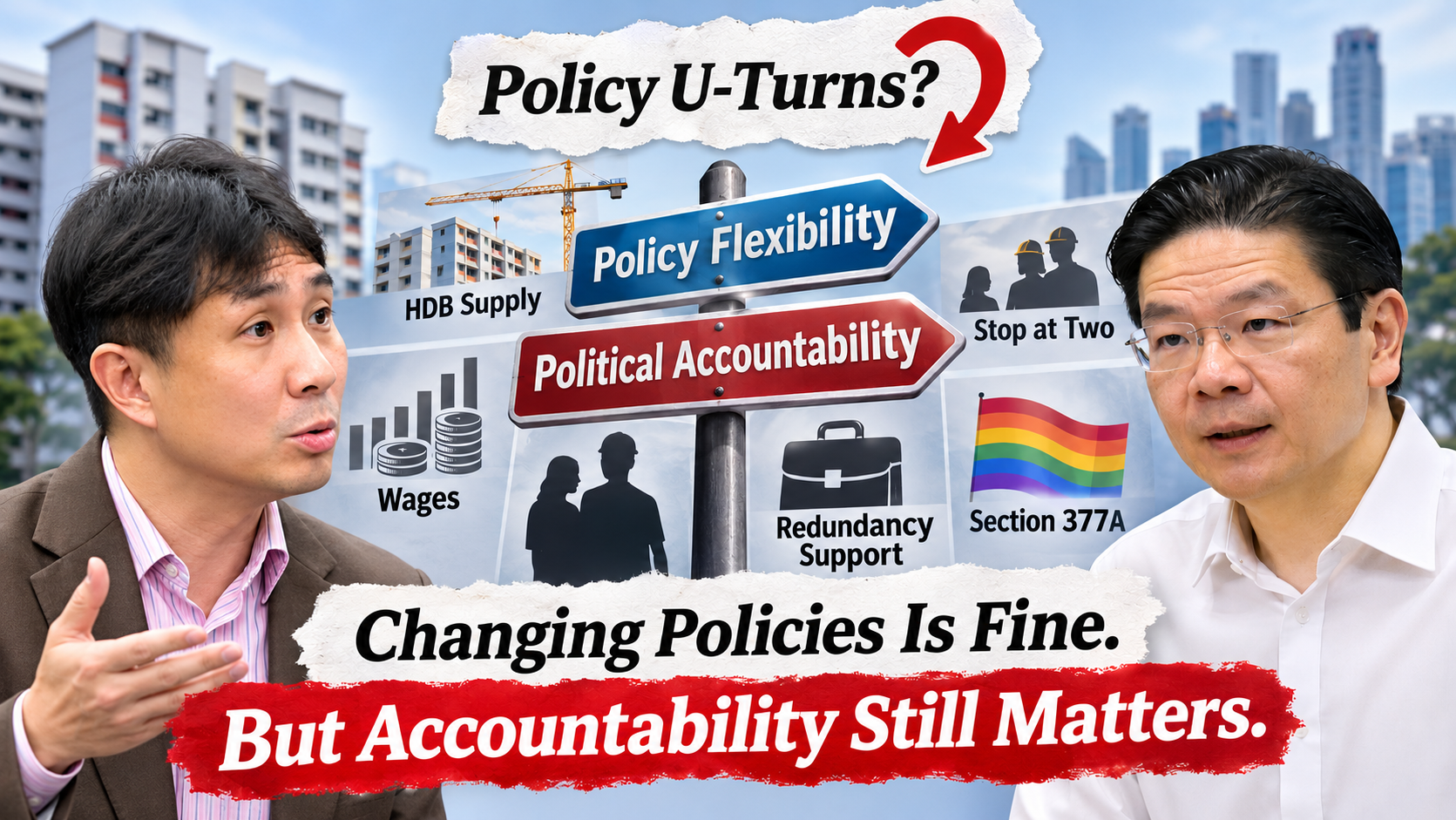
His central argument is that the PAP has also made numerous policy U-turns, citing Stop at Two, redundancy insurance, minimum wages and Section 377A.
Therefore, he suggests that the PAP is guilty of the very thing it accuses the Workers’ Party of doing.
But this is a false equivalence.
Changing Policies Is Not the Same as Changing Positions
There is nothing inherently wrong with changing policies. Governments should adjust their policies when circumstances change, when new evidence emerges or when an earlier approach proves ineffective. Nobody expects a government to remain stubbornly committed to a policy simply to preserve the appearance of consistency.
However, there is a fundamental difference between changing a policy because circumstances have changed and changing one’s position without adequately explaining the underlying rationale or policy trade-offs.
That is the distinction Jamus seems to miss.
The PAP’s Policy Changes Had Their Own Context and Rationale
Consider the examples he brought up.
The Stop at Two policy was introduced in a very different demographic and socio-economic environment from the one Singapore faces today. In 1959, only 9% of Singapore’s population lived in public housing. Many lived in overcrowded kampongs and urban slums. Unemployment was high, and the country faced very different economic and social challenges.
The repeal of Section 377A followed years of social and constitutional developments. These were not simply arbitrary reversals made on a whim.
Likewise, introducing the Progressive Wage Model is not the same as adopting a universal minimum wage.
The Government, in fact, had explicitly rejected a one-size-fits-all universal minimum wage in favour of a sectoral approach.
The reasoning was straightforward: different industries have different productivity levels, wage structures and capacities to absorb higher labour costs. A uniform wage floor could impose disproportionate pressure on businesses in sectors that are less able to sustain such increases, potentially putting employment at risk.
Providing temporary financial assistance to retrenched workers is not necessarily equivalent to implementing the WP’s proposed redundancy insurance scheme.
In recent debates, WP MPs themselves explicitly said in Parliament that their redundancy insurance scheme is different from the Government’s Jobseeker Support Scheme.
For Jamus to now claim that it is a version of their redundancy insurance scheme is inconsistent with what his party’s MPs said in Parliament.
Policies must be assessed on their design, objectives, financing and consequences, not merely grouped together because they address similar issues.
But What About the WP’s Own Changing Positions?
More importantly, Jamus spends considerable effort pointing out the PAP’s policy changes but does considerably less to explain the WP’s own changing positions.
When the Workers’ Party spoke about managing HDB supply, it was in the context of lease decay — a looming policy problem that will unfold over the next two decades — and not the short-term construction disruptions caused by the pandemic.
This is how Jamus seeks to explain the WP’s positions on HDB supply.
But let’s look at what the WP actually said.
HDB Supply: What the WP Actually Said in 2019
The WP’s 2019 Working Paper explicitly raised the question of whether continued BTO supply of 16,000 to 17,000 flats annually, alongside private housing completions, could result in a surplus of housing and a vacancy problem by 2022.
Context matters. But context must be grounded in what was actually written in the paper. In this instance, Jamus is asking us to look at a different context from the one addressed in the WP’s own Working Paper.
Despite raising concerns about a possible surplus of BTO flats by 2022, the WP subsequently criticised the Government in 2023 for not building flats ahead of demand. It called for the Government to abandon what Pritam Singh described as the “sacred cow” of not building ahead of demand.
What was missing from this criticism was a proper acknowledgment of the WP’s earlier position and the fact that the COVID-19 pandemic had disrupted HDB’s construction programme, resulting in delays and a supply crunch.
Foreign Workforce: From Flexible Arrangements to Zero Growth
Jamus also argues that the WP has always recognised that Singapore needs a foreign workforce, and that its concerns have been about moderating the pace of inflows and managing the pressures on infrastructure and institutions.
But this explanation does not explain why in 2012, the WP advocated a flexible arrangement that would allow different industries to manage their foreign manpower needs according to their circumstances.
And then, in early 2013, the party called for zero growth in the foreign workforce.
These are two different policy positions with significantly different implications for businesses and the economy.
What changed between 2012 and 2013? Why did the party abandon its earlier proposal, and what considerations led it to embrace a zero-growth position?
The question is not whether Singapore needs foreign workers. It is whether the WP can explain the rationale behind its changing policy positions, particularly when those positions have very different implications for businesses, workers and Singapore’s economic competitiveness.
Policy Flexibility Does Not Excuse Political Accountability
Jamus says that changing one’s position is a mark of wisdom and maturity. I agree.
But wisdom also requires acknowledging why the previous position was wrong, explaining what has changed and taking responsibility for the consequences of the original proposal.
There was no meaningful acknowledgment of what the WP had advocated in 2019, its concerns about a potential BTO surplus by 2022, or how the pandemic had fundamentally changed the housing supply situation.
Instead, the WP criticised the Government for not building in advance, without adequately accounting for the unprecedented construction disruptions caused by the pandemic.
Policy flexibility is a virtue. Political accountability is an obligation. One does not replace the other.
The PAP should be held to the same standard. But pointing to the PAP’s policy changes does not, by itself, answer the questions raised about the WP’s own positions.
Singaporeans deserve more than a debate about which party has made more U-turns. They deserve to understand the reasoning behind each party’s proposals, the trade-offs involved and whether those proposals can stand up to scrutiny.