Is the PSP’s Affordable Housing Scheme as great as it looks?
The PSP (Progress Singapore Party) proposed to making public housing more affordable by excluding land costs in the price of the flat.
On the surface, it seems like a great deal for buyers since they would only need to pay $140,000 for a Build-To-Order (BTO) flat in Tengah instead of the typical $300,000.
But here’s the catch.
While the initial purchase price is lower, should the buyer decide to sell his flat later on, he would have to pay for land costs with accrued interests.
(1) Prepaid Rental Scheme?
This deferred land cost mechanism shifts the nature of ownership.
Instead of owning the flat outright, the buyer is essentially participating in a prepaid rental scheme with an ‘option to buy’ later on.
The flat may not be a true asset in the traditional sense, as its value is artificially capped by the future obligation to pay the land costs upon resale.
(2) The Financial Dilemma
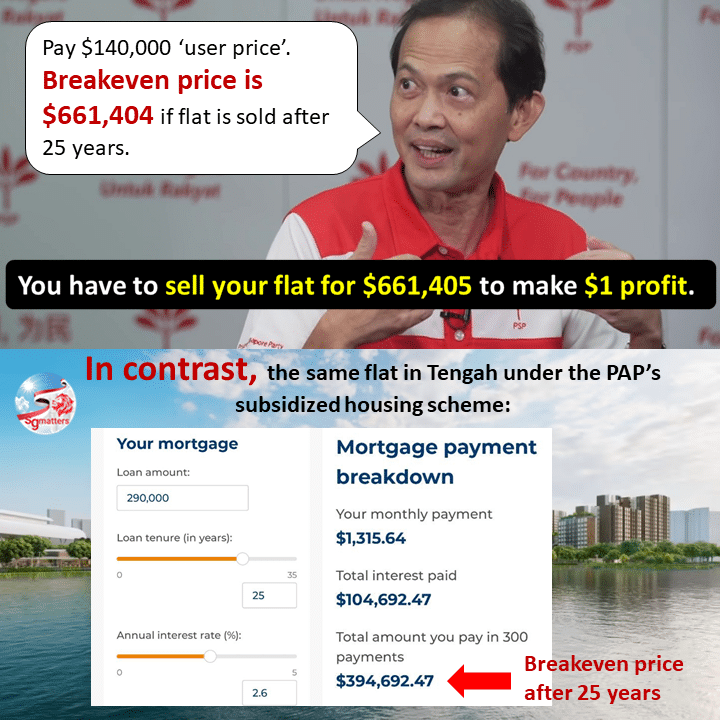
In Leong Mun Wai’s own estimation, a buyer who purchases a flat for $140,000 under the AHS would need to sell it for $661,404 after 25 years just to cover the deferred land costs and break even.
The concern here is whether the buyer would be able to afford such a large payment (more than half a million dollars) down the road.
If the buyer is unable to afford half a million dollars to pay for land cost with accrued interests, then the flat would essentially become an asset they can never profit from or even fully exit from.
This will leave the buyer “condemned” to staying in the flat for life, unable to sell or upgrade.
(3) Long term implication of deferred land costs and the real cost of ownership
A housing scheme that excludes land costs means that a huge portion of the asset value of his flat has been written off.
While the scheme may offer short-term affordability, the real cost of ownership in terms of resale could be far higher than anticipated because of its deferred land cost with accrued interest obligations.
The long-term implication of such a housing scheme with deferred land costs will trap buyers in a difficult financial situation.
This makes it more of a long-term commitment than buyers may realize.
Is the trade-off of a lower upfront cost worth the deferred financial burden in the future? This is something to be carefully considered.
In Leong Mun Wai’s own words, “The deferred land cost feature prevents the AHS owner from profiteering from selling his flat.”
In short, the scheme is designed to make the flat very costly for the owner to sell so that he can’t profiteer from it.