It is often suggested that Singapore’s strong performance in OECD assessments is largely driven by its extensive tuition industry. But this claim does not hold up against the evidence.
If private tuition were the primary driver of national performance, we would expect two clear patterns:
Students who cannot afford extensive tutoring would lag behind international averages.
There would be a steep performance drop among lower-income students.
Yet that is not what the data shows.
Lower-Income Students Also Outperform the OECD Average
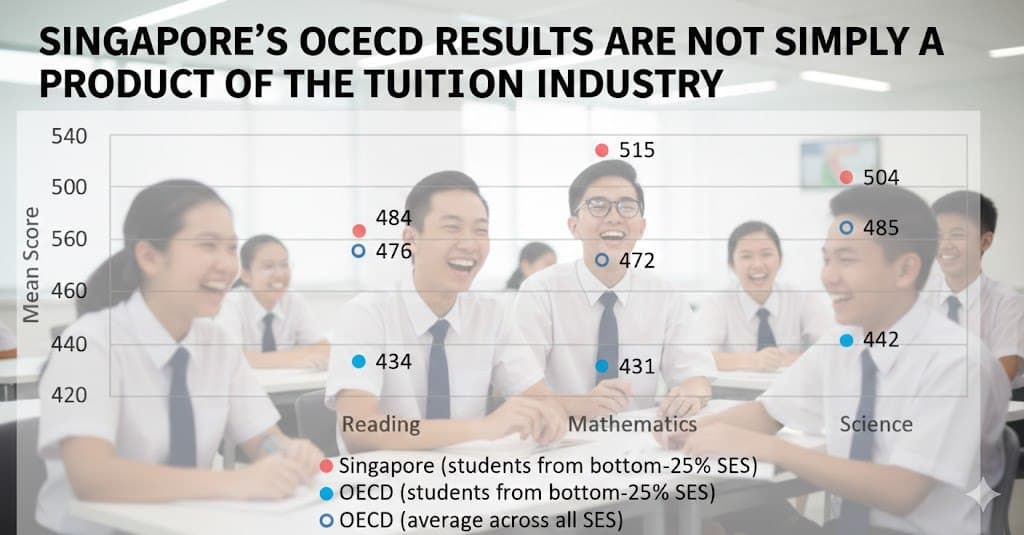
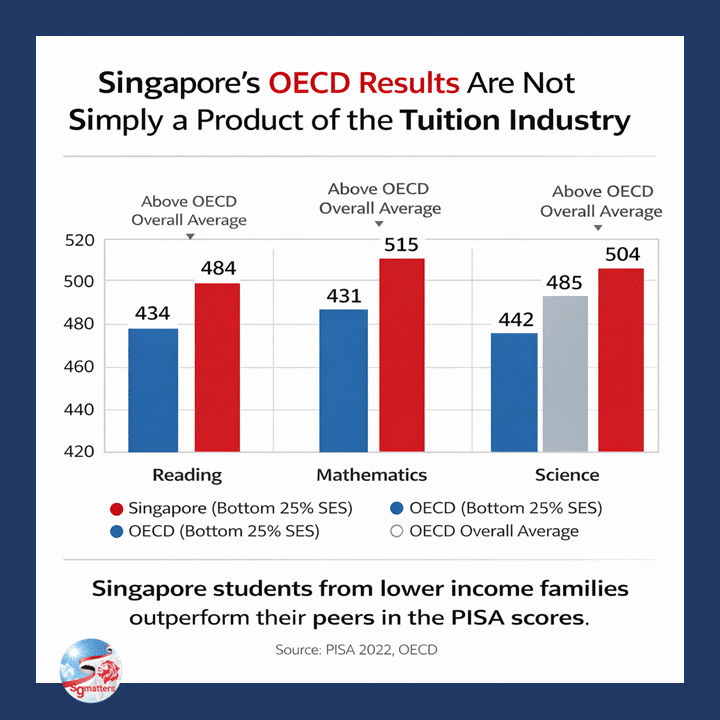
Under the OECD’s Programme for International Student Assessment (PISA), Singapore’s students from the bottom socio-economic quartile — those from lower-income households — still score above the overall OECD average in reading, mathematics, and science.
This is a crucial point.
Students with fewer financial resources, and therefore more limited access to private tuition, are not merely keeping pace. They are outperforming the international benchmark.
If tuition were the decisive factor, such results would be highly unlikely. Instead, the evidence suggests that the foundation of performance lies within the mainstream education system itself.
PISA Measures Competency, Not Memorisation
PISA does not primarily test rote learning or narrow exam drilling. It assesses:
Problem-solving
The application of knowledge to unfamiliar contexts
Analytical reasoning
If Singapore’s outcomes were largely the product of tuition-centre drilling, we would expect weaker performance on novel and transfer-based tasks. Instead, Singapore consistently ranks at or near the top globally.
This indicates that students are developing transferable competencies — capabilities cultivated through curriculum design, classroom instruction, and sustained teacher guidance, not short-term exam coaching.
The Pattern Points to System-Level Strengths
If tuition were the main engine of success, results would be highly stratified — with strong outcomes concentrated among wealthier families who can afford extensive enrichment.
But Singapore’s lower-income students perform not just adequately, but competitively on a global scale.
That pattern points to systemic strengths such as:
Curriculum coherence
Strong teacher preparation and professional development
Structured, well-sequenced pedagogy
Effective school leadership
Early emphasis on literacy and numeracy foundations
These are features of public policy and institutional design — not private market forces.
The More Convincing Explanation
Tuition may provide incremental advantages for some students. But it does not explain why students with limited access to private tutoring still exceed OECD averages.
The more compelling conclusion is this:
Singapore’s strong OECD performance is fundamentally a system achievement — rooted in the quality and design of its public education system — rather than a by-product of its tuition industry.
If tuition were the engine, lower-income students would fall behind internationally.
They do not.
That distinction matters.