
In a recent Facebook post, Tan Kin Lian recently wrote to the Chair of the board of directors of Income Insurance, arguing that a 1991 endowment policy will mature this year with a payout about 25 per cent lower than what was originally illustrated. He described this outcome as “unjustified,” claiming that the investment environment should have supported stronger returns.
While such disappointment is understandable, his letter overlooks the broader context that determines how participating (par) policies actually work.
As Ho Ching explained in her Facebook post in response, par policies are not guaranteed investments. They are long-term risk-sharing arrangements shaped by decades of economic change.
A Different World For Returns
The 1980s and early 1990s were a high-return era. Global interest rates hovered around 6–8 per cent, fuelling generous par fund bonuses. But that world disappeared after the 1997 Asian Financial Crisis, the 2000 dot-com bust, and the 2008 Global Financial Crisis.
For the last two decades, interest rates and bond yields – the backbone of insurers’ portfolios – stayed at historic lows. In such an environment, it was simply impossible for life insurers to replicate the returns achieved by earlier generations.
The reality is that a policy bought in 1991 reflected assumptions from that high-yield world. Expecting the same performance 34 years later ignores the long global decline in returns since the late 1990s.
Illustrations Are Not Promises
Before 1994, there were no industry-wide limits on the investment returns insurers could use when illustrating policy benefits. Some used rates above 7 per cent.
In 1994, the Life Insurance Association introduced caps on illustrated returns (initially 5.25 per cent, later reduced to 4.25 per cent) to align projections with a more realistic long-term outlook.
A 1991 illustration therefore reflected an earlier, more optimistic assumption. It was never a binding commitment but an estimate based on the conditions of the time.
Fairness Across Generations
Ho Ching rightly emphasises that participating policies are about sharing – not just profits, but risk – across generations of policyholders.
Bonuses are determined by each cohort’s asset share: the value of its contributions and returns after expenses. Actuarial guidelines, such as the Singapore Actuarial Society’s SAP L03, require insurers to ensure that no generation takes a disproportionate share of the par fund’s surplus.
If older policies were paid extra simply to meet outdated projections, newer policyholders would unfairly bear the cost. Preserving intergenerational equity is therefore both fair and essential to a fund’s long-term health.
In Income’s own product summaries, verbatim: “In determining sustainable bonus rates… we look to their asset share, which is the value of the assets available to back the policy. It is calculated as the total premiums received plus actual investment returns and other profits… less expenses and charges and other outgo.” Each policy’s payout thus should represent its fair share of the par fund’s cumulative results.
2009 Restructuring Was Prudence, Not Broken Promise
Mr Tan cites Income’s 2009 bonus restructuring, which shifted some annual bonuses to terminal (special) bonuses, as a broken promise.
In fact, the move strengthened the fund’s flexibility and resilience during a volatile period.
Special bonuses are non-guaranteed by design. They exist precisely so insurers can adjust payouts according to actual fund performance. Any commitment to “increase” them was conditional, not absolute.
Industry Data Supports Ho Ching’s View
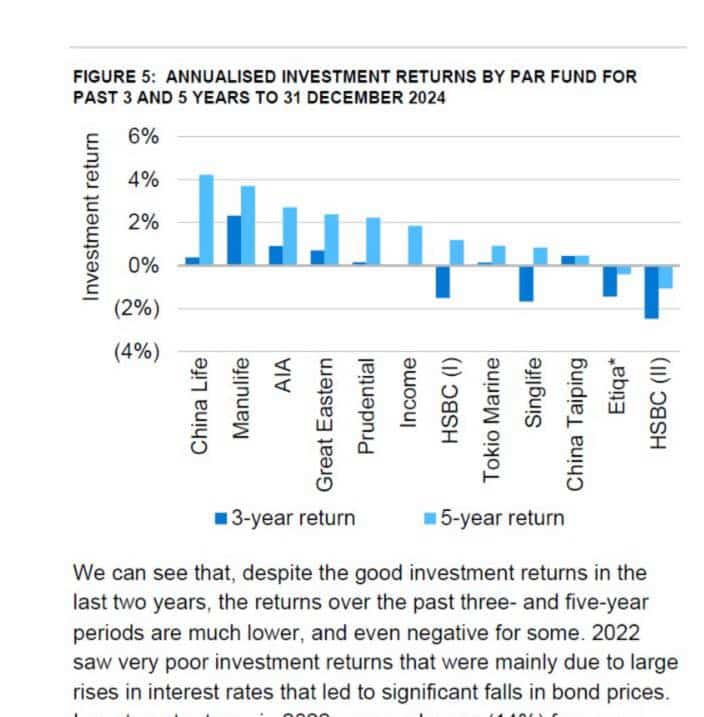
Independent evidence bears this out. Milliman’s 2025 report on Singapore’s par funds shows that NTUC Income was neither the best nor the worst performer over the past five years. It was squarely in the middle. Its long-term returns of around 3–5 per cent per annum are consistent with global trends.
This demonstrates that the reduction in payout is not a sign of mismanagement but a reflection of the world’s changed economic realities.
Financial Realism Protects Everyone
Ho Ching’s post ultimately delivers a crucial reminder: participating policies are not fixed deposits. Their non-guaranteed benefits depend on future investment outcomes. And those outcomes can swing with global interest rates, inflation, and even climate-related shocks.
Recognising this is not defeatism; it is financial realism. The responsible approach is to demand transparency and fairness in how bonuses are determined, not to insist that old illustrations must hold in a new era.
In Conclusion
Tan Kin Lian speaks to the emotional disappointment of policyholders who expected more.
Ho Ching encourages a more informed understanding of how par funds work. Her explanation speaks to the hard actuarial truths that keep the system fair and sustainable.
Participating policies are a collective promise, one that spans generations. Protecting that promise requires prudence, equity, and transparency, not nostalgia for the investment world of 30 years ago.
In that light, Ho Ching’s perspective is not only reasonable, it’s essential.
Reference:
Ho Ching’s Facebook post:
https://www.facebook.com/photo?fbid=3030452610475886&set=a.403673546487152
Tan Kin Lian’s Facebook post:
https://www.facebook.com/permalink.php?story_fbid=pfbid02EERJXJRZHSpZgwshKgjbfzdkeXveX9pfUEBuFrgVu64z3UEpSZ4JNTMHNw4EM6Hbl&id=100045577148564