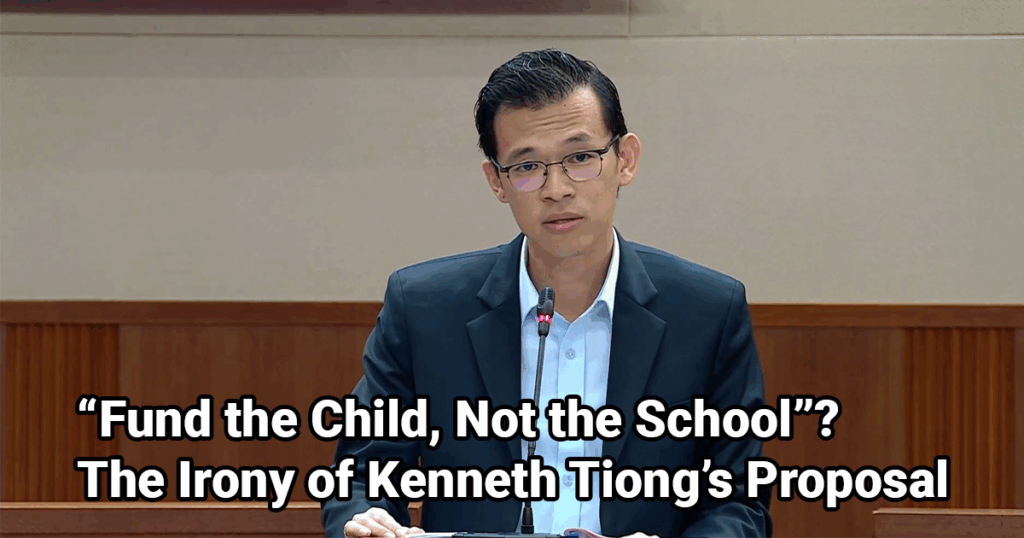
Kenneth Tiong’s recent adjournment motion, “Fund the Child, Not the School”, calls for a universal portable preschool voucher, arguing that subsidies should follow the child rather than the institution.
On the surface, this sounds pro-child. Yet the irony is hard to miss: much of his speech focuses not on improving access or outcomes for children, but on protecting independent preschools from competition with large government-supported operators.
While the motion suggests that children’s welfare is at stake, much of Tiong’s analysis revolves around the plight of independent preschools – falling enrolments, struggles to meet Partner Operator (P-OP) criteria, and difficulty competing with Anchor Operators (A-OPs) and MOE kindergartens. The child’s welfare is invoked rhetorically to justify measures that are, in reality, institution-centered.
A system already designed for children
Singapore’s existing preschool framework already places the child at the heart of policy. In 2019, Prime Minister Lee Hsien Loong announced that by around 2025, 80% of preschoolers would have a place in a government-supported preschool.
The goal: to make quality early childhood education as accessible and affordable as public housing. By intervening early, the government ensures that every child has a good start in life and that social mobility remains fluid.
Anchor Operators and Partner Operators are required to meet both quality and affordability standards, ensuring that every child receives developmentally appropriate education at reasonable fees.
Partner Operators, though privately owned, collaborate with the government to expand access while maintaining standards. This combination of public oversight and private initiative already balances quality, access, and diversity — and is explicitly child-focused.
Why vouchers are neither fair nor efficient
By contrast, a universal voucher would fund every child equally, regardless of family background. This sounds fair but is actually neither equitable nor efficient.
Wealthier families can “top up” beyond the voucher value, while lower-income families may still struggle to afford premium centres.
The outcome: public funds disproportionately benefit those who need them least, while diverting resources from targeted support for disadvantaged or special-needs children.
The deeper issue behind ‘competition’
Diversity in preschools is important, but it does not require universal vouchers. Singapore’s mix of A-OPs, P-OPs (which are private businesses), and independent centres already provides pedagogical variety.
Tiong cited one operator who told him, “Even zero rent also cannot survive.”
But if an independent preschool operating rent-free is still unable to compete, then the issue runs deeper than competition alone. It points to structural problems such as curriculum relevance, quality perception, management inefficiency, or demographic change, rather than market distortion.
A-OPs and P-OPs were introduced precisely to raise quality and affordability across the sector. If parents prefer these centres or MOE kindergartens, that reflects confidence and value, not unfairness.
So Kenneth, it’s worth asking: if a rent-free preschool still cannot survive, is the real problem the system — or the school?