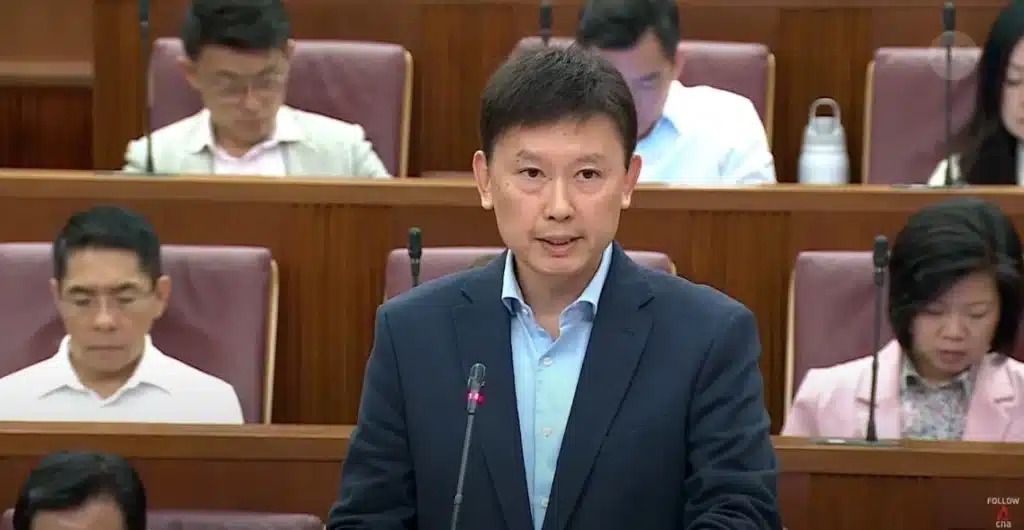
The reliability of a train depends on several factors, and not only on its age alone. Trains that remain reliable can continue to be used, if they have not exceeded their service life, Transport Minister Chee Hong Tat said in a ministerial statement in Parliament (15 October 2024).
The structural integrity of the first generation Kawasaki Heavy Industries(KHI) trains was assessed by an independent assessor in 2012, who concluded that the trains have a total service life of 38 years.
Prior to 2016, all the trains were owned and operated by the rail operators.
In 2016, LTA began taking ownership of rail operating assets as part of the transition to the New Rail Financing Framework (NRFF). Under his framework, LTA is responsible for procuring and building-up assets such as the train fleet, while rail operators are responsible for maintaining, deploying, and operating the assets.
In 2018 and 2020, LTA purchased a total of 106 new R151 trains to replace the North-South and East-West Lines’ earliest generations of trains, including the KHI fleet. The delivery of these trains however was delayed by the COVID-19 pandemic.
These trains have been arriving in batches, after rigorous testing. The first batch of three trains was handed over to SMRT and put into service in June 2023.
Since then, LTA has been progressively handing over new R151 trains to SMRT, at a rate of about two trains per month. 34 R151 trains have been handed over to SMRT so far.
The plan is to replace all the KHI trains with the new R151 trains by end-2026, before they reach their 38-year service mark, Minister Chee said.
Reliability
The Mean Kilometres Between Failure (MKBF) for the MRT network is a reliability benchmark used by cities globally. It measures the distance travelled by a train before a delay of more than 5 minutes happens.
MKBF statistics are tabulated regularly, and publicly reported on LTA’s website.
All the MRT lines have achieved the set target of at least 1 million train-km.
a. East-West Line – 2.03 million;
b. North-South Line – 1.42 million;
c. North East Line – 2.05 million;
d. Circle Line – 1.04 million; and
e. Downtown Line – 8.11 million.
Recap on what happened on 25 September 2024
At around 9am, smoke was detected from a first-generation Kawasaki train that was travelling eastbound on the East-West Line near Clementi station.
The train was stopped at Clementi station where passengers alighted for their safety. Thereafter, SMRT proceeded to withdraw the train to Ulu Pandan Depot.
As the train travelled west between Dover and Clementi stations, an axle box dislodged from the bogie of one of its cars. This caused the wheels of one bogie to shift to the side of the rail.
A six-car train has 12 bogies altogether. As the other eleven bogies of the incident train remained on the rails, the train was able to continue travelling for a few minutes on the rails westbound past Clementi.
Preliminary assessments show that 2.55km of the track, as well as trackside equipment, including point machines, power cables, running rail fasteners, and third rails were damaged.
The significant damage to the trackside equipment caused a power trip along parts of the East-West Line and stalled the train.
Four other trains between Clementi and Buona Vista stations also stalled due to the power trip.
The severe damage to rail infrastructure required extensive repairs over more than five days.
LTA will conduct a thorough investigation to ascertain the root cause of the axle box failure. It will also examine the fault detection and incident handling procedures, to determine if appropriate actions were taken.
To supplement its investigations, LTA will be supported by an Expert Advisory Panel, chaired by Mr Malcolm Dobell, former Head of Train Systems for the London Underground, and comprising five other local and overseas experts.
MOT’s Transport Safety Investigation Bureau (TSIB) will also be conducting an independent safety investigation.
Investigations are expected to be completed in the next few months, and the findings will be released publicly.